


A villa can feel financially simple when you are looking at the brochure: purchase price, down payment, loan amount and EMI. But after possession, a second number begins to matter just as much — the villa maintenance cost.
That number is not only about paying someone to clean a garden or repair a tap. In a gated community, residents collectively fund the systems that make the larger neighbourhood usable: security, internal roads, common lighting, landscaping, drainage, water systems, waste handling and shared amenities. At the same time, every villa owner also carries the separate cost of maintaining the private home itself.
For a family comparing a villa in Bhubaneswar or a villa in Phulnakhara, understanding this difference before booking is important. A low headline maintenance figure can look attractive, but it means very little until you know what it includes, how it is calculated and what may be charged separately later.
Quick Answer
There is no single “standard” villa maintenance cost that applies to every project. The recurring ownership budget usually has four layers: common area maintenance, private villa upkeep, individual utility consumption and long-term repair/reserve contributions such as a sinking fund or corpus fund where applicable. Ask for each layer separately in writing before you compare two projects.
Most families spend weeks comparing home-loan rates and purchase prices. Far fewer compare the monthly maintenance charges with the same discipline. That is a mistake because maintenance is not a temporary expense. It is part of the long-term villa ownership cost.
In a well-run community, maintenance spending is not “wasted money.” It is what keeps shared assets working. The useful question is not “How can I pay the lowest possible maintenance?” It is “What level of service and asset upkeep am I paying for, and is the calculation transparent?”
For example, a project with landscaped areas, controlled entry, a pool, gym, walking track, clubhouse and other shared facilities will naturally have a different operating requirement from a small gated layout with only roads and streetlights. A buyer should compare the maintenance model with the actual community infrastructure, not with an unrelated project.
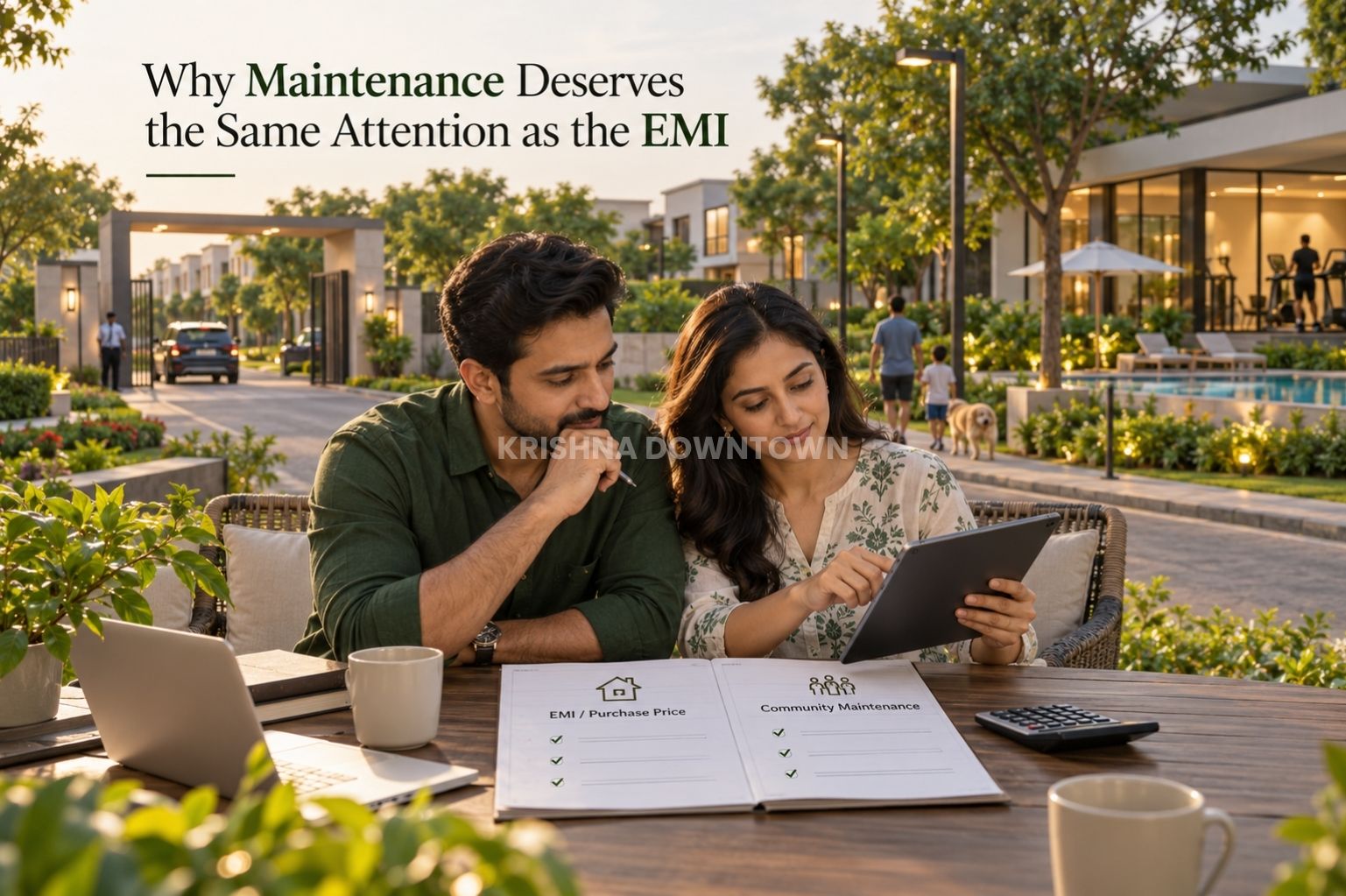
The phrase villa maintenance cost is often used as if it were one bill. In practice, it is easier to understand it as four separate wallets:
| Cost Layer | Typical Examples | Who Usually Pays / Controls It |
| Community operating cost | Security, common lighting, common landscaping, waste handling, common water systems, amenity operation, common housekeeping. | Collected under the project/association maintenance mechanism as applicable. |
| Private villa upkeep | Interior plumbing, private electrical repairs, appliances, private paint, individual roof/terrace upkeep, pest control, private garden work. | The individual villa owner. |
| Individual consumption | Electricity inside the villa, internet, personal LPG/energy use, individual water charges where separately metered/billed. | The individual household, depending on the project utility arrangement. |
| Long-term reserve / capital repairs | Road resurfacing, major pump replacement, boundary repairs, large common-equipment replacement, major repainting or other future common works. | May come from a sinking fund, corpus fund, reserve or special contribution, depending on the governing documents and association budget. |
This separation is important. A project can quote reasonable villa maintenance charges and still require the owner to budget independently for private-home upkeep and future capital expenses.
Common area maintenance generally relates to the spaces and systems residents share. Depending on the project, that can include entry security, internal roads, common drainage, streetlights, garden areas, common water infrastructure, club facilities, sports areas and housekeeping of shared spaces.
The maintenance agency does not automatically become responsible for everything inside your villa. A leaking tap in a private bathroom, an ageing AC, interior repainting, damage to a private gate, a personal garden upgrade or a kitchen-appliance repair may remain the owner’s responsibility unless the written maintenance scope says otherwise.
This is why comparing only the society bill can understate the real cost of maintaining a villa.
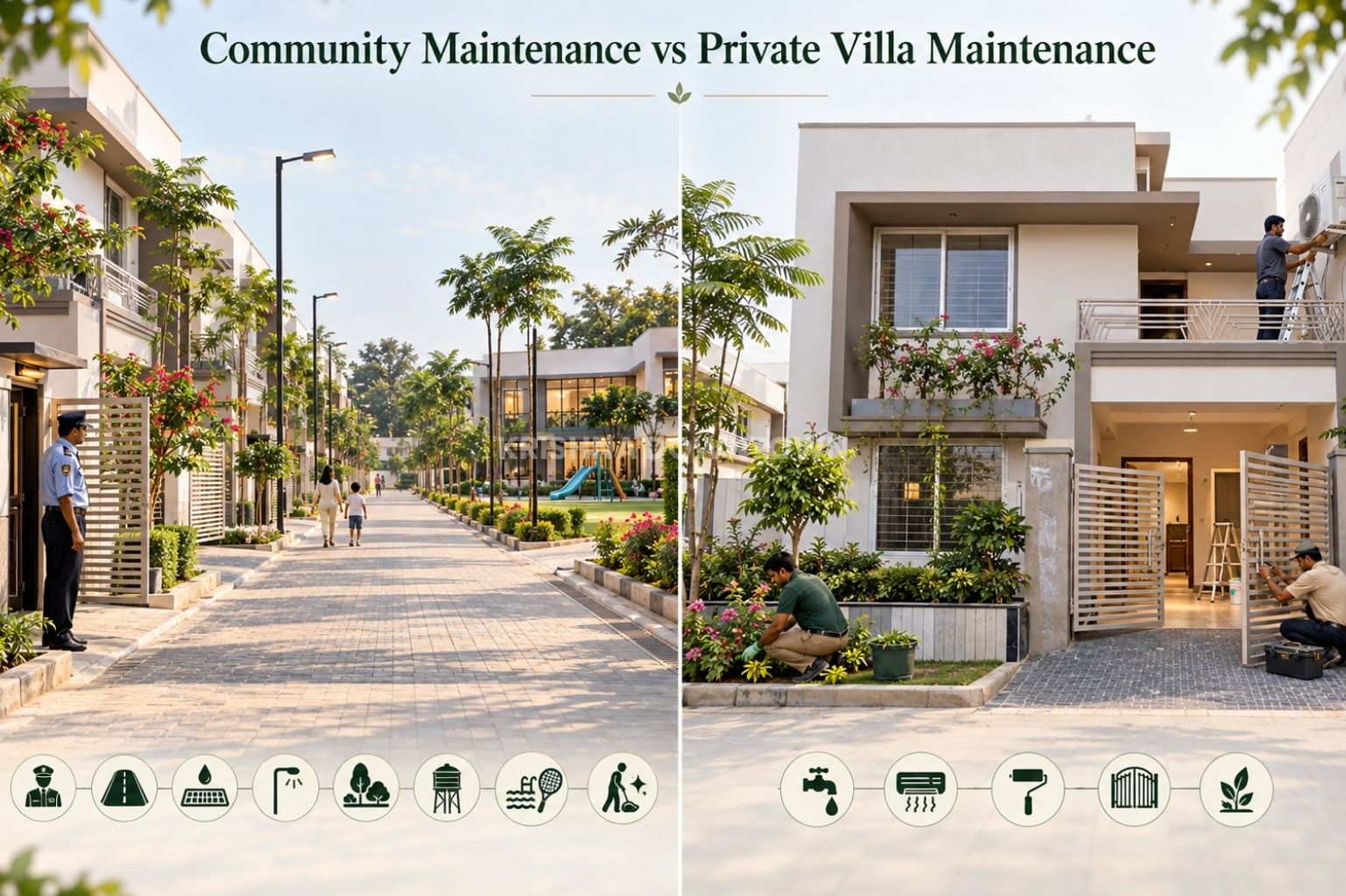
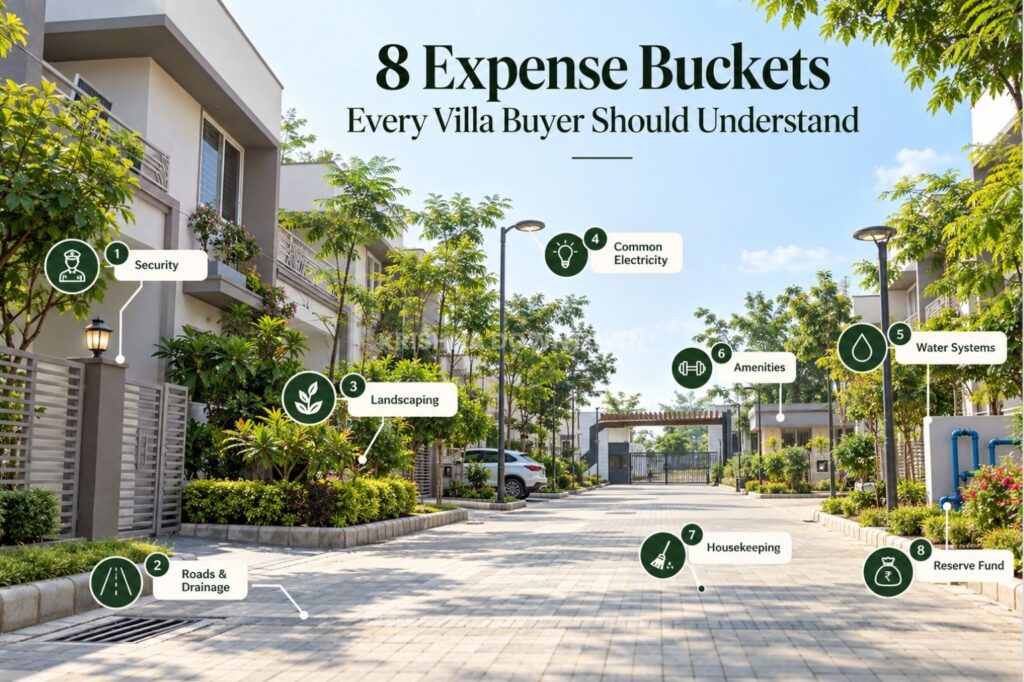
A gated community needs more than a boom barrier. Staffing, visitor management, gate operations, CCTV upkeep where provided and perimeter monitoring can be recurring expenses. Ask what security model is included in the gated community maintenance charges and whether technology subscriptions or additional guards are billed separately.
Internal roads, stormwater paths, drains, common paving, boundary walls and related civil assets deteriorate over time. Routine cleaning is one cost; major resurfacing or repair is another. Ask which items come from the monthly budget and which are expected to come from a reserve or special levy.
Greenery creates daily value, but it also needs pruning, seasonal planting, irrigation, lawn care and waste removal. In a nature-led villa community, landscaping can be a meaningful line item rather than a decorative afterthought.
Streetlights, gate equipment, common pumps, clubhouse power, landscape lighting and other shared systems consume electricity and require servicing. Ask whether common electricity is included in the quoted monthly maintenance charges or billed as a separate variable component.
Water supply arrangements vary by project. Common pumps, storage tanks, filtration or treatment systems, sewage/stormwater infrastructure and landscape irrigation may create operating expenses. Do not assume “maintenance includes water” unless the scope clearly says so.
A swimming pool requires filtration, cleaning, chemicals and equipment servicing. A gym needs equipment upkeep. A clubhouse, banquet area, indoor games space or sports court needs cleaning, lighting and periodic repair. The more infrastructure the community operates, the more important it is to understand the maintenance budget behind the amenity list.
Common-area cleaning, waste collection coordination, office/accounting expenses, maintenance staff and vendor management are part of running a community. Ask how frequently the budget and accounts are shared with residents after the association takes over.
Routine maintenance keeps the community functioning today. A reserve helps prepare for tomorrow. Roads, pumps, gates, external common structures and large equipment eventually need major repair or replacement. Ask whether the project has a sinking fund, corpus fund or another reserve mechanism and how it will be governed.
There is no universal calculation method across every project. A community may use an area-based formula, a proportionate method, a fixed component, variable utility components or a combination, subject to the project documents and applicable law. This is why buyers should ask for the calculation basis instead of comparing only the final monthly number.
| Buyer Rule Never compare “₹4,000 vs ₹6,000 per month” without first asking: What area or unit basis is being used? What services are included? What is billed separately? Is this an introductory/advance period or the expected association-run budget? |
If a developer quotes maintenance before possession, request a written schedule that identifies the period covered, the rate/basis, the included services, advance maintenance if any, reserve/corpus contributions if any, taxes if applicable, and the process for future revision or handover.
A very low property maintenance cost can be genuinely efficient — or it can mean the community is under-budgeted, certain services are excluded, unsold inventory is subsidising early operations, or larger repair costs are being postponed. A buyer cannot know which is true from the headline number alone.
The more useful test is sustainability. Ask whether the budget can reasonably support the security, landscaping, roads, common utilities and amenities promised. Then ask what happens after occupancy rises and the association of allottees takes over maintenance.
A transparent project should be able to explain the maintenance logic without pressure or vague assurances.
Under Section 11(4)(d) of the Real Estate (Regulation and Development) Act, 2016, the promoter is responsible for providing and maintaining essential services on reasonable charges until the association of allottees takes over maintenance. The exact contractual responsibilities and charges still need to be read with the project documents and applicable state framework.
For apartment projects, the Odisha Apartment (Ownership and Management) framework also addresses common expenses, maintenance, repair and replacement of common areas and the role of the association of allottees. The practical takeaway for a buyer is simple: understand who is responsible now, when handover occurs, what money transfers with that handover, and how future common expenses will be governed.
| Important This article provides buyer education, not legal or tax advice. Before committing funds, review the registered agreement, applicable RERA disclosures, maintenance schedule, association documents and project-specific terms. Use ORERA and official Odisha government sources for verification. |
Instead of asking for one magic maintenance number, build a simple four-line home maintenance budget before you buy:
| Budget Line | What to Enter | How to Verify |
| A. Community maintenance | The current recurring charge or approved budget contribution. | Get the amount, basis and included services in writing. |
| B. Private villa upkeep | A household reserve for plumbing, electrical, appliance, paint, pest control, terrace/roof and private garden needs. | Estimate from your home specification, age, family usage and service contracts. Do not copy another city’s number. |
| C. Individual utilities | Electricity, internet and any separately billed water/energy services. | Check meter/billing arrangements and past/current tariff basis. |
| D. Periodic / reserve contributions | Any corpus fund, sinking fund, advance maintenance or special capital contribution. | Review agreement, association budget and handover documents. |
Then calculate your villa ownership cost using actual written inputs rather than a market average:
| Simple Ownership Formula Annual running budget = (community maintenance × 12) + expected private-villa upkeep + individual utilities + any known annual/periodic reserve contributions. Keep purchase EMI, property tax, insurance and major personal upgrades as separate budget lines so you can see the true recurring cost clearly. |
For buyers comparing a villa near Bhubaneswar, the maintenance conversation should be connected to the physical site. A community with landscaped open areas, long internal roads, multiple amenities or extensive common infrastructure requires a clear operational plan. During a site visit, do not only look at how attractive those spaces are — ask how they will be maintained after full occupancy.
In Phulnakhara, where buyers may be comparing gated villas with standalone houses or apartments, the relevant comparison is not simply “maintenance vs no maintenance.” A standalone house also has security, exterior repair, drainage, garden and infrastructure costs; they are simply paid individually rather than through a shared community budget. Compare total responsibility, not just the monthly invoice.
The official Krishna Downtown website positions the project as a gated 3/4 BHK villa community in Phulnakhara near Bhubaneswar, with shared amenities including a swimming pool, gym, garden space, walking track, clubhouse/community spaces, sports/recreation areas and car-wash facilities. Those shared spaces are relevant to a villa maintenance cost discussion because every amenity creates an operating and upkeep requirement.
However, the current public website does not provide a maintenance rate that should be treated as a verified buyer quote. Therefore, buyers should request the current maintenance amount, calculation basis, advance period if any, included services, excluded utilities, reserve/corpus structure and handover mechanism directly from the Krishna Properties and Developer team in writing before making a financial comparison.
That approach is more useful than assuming that one generic market rate applies to every gated community in Phulnakhara.
A sensible villa maintenance cost is not necessarily the lowest one. It is the one that is transparent, connected to real services, sustainable for the community and clear enough for the family to budget without surprises.
Before buying a villa in Bhubaneswar or villa in Phulnakhara, ask for the maintenance model with the same seriousness you give the floor plan, loan sanction and sale agreement. Know what the community pays for, what you pay privately, what may change after handover and what reserve exists for major future repairs.
That is how a family moves from “Can we buy this villa?” to the more important question: “Can we own and maintain it comfortably for the long term?”
| Soft CTA Considering Krishna Downtown, Phulnakhara? During your project discussion or site visit, ask the team for the current written maintenance structure alongside the villa configuration, project documents and availability. A transparent ownership-cost discussion is one of the best ways to compare a home responsibly. |
It depends on the project. Villa maintenance cost in a gated community may cover security, common lighting, landscaping, roads, drainage, common water systems, housekeeping, waste management and shared amenities. Private repairs inside the villa and individual utilities may be separate. Always request the scope in writing.
Usually, buyers should not assume that villa maintenance charges will remain unchanged forever. Costs can change with vendor rates, occupancy, service levels, utilities, repairs and association budgets. Review the agreement and the process for revisions or association decisions.
Not automatically. Common-area electricity may be included or separately passed through, while household electricity is generally individual. Water arrangements vary by project. Ask whether water, pumping, common electricity and backup power are included, metered or billed separately.
Monthly maintenance charges generally fund routine operations. A corpus fund or sinking fund, where applicable, is intended for longer-term or larger common expenses according to the governing documents and association decisions. Buyers should ask how each fund will be used and accounted for.
Section 11(4)(d) of the Real Estate (Regulation and Development) Act, 2016 places responsibility on the promoter to provide and maintain essential services on reasonable charges until the association of allottees takes over maintenance. Project-specific obligations should still be checked in the agreement and state framework.
Compare the calculation basis, included services, variable charges, amenity footprint, reserve funds, handover mechanism and private-home responsibilities. Comparing only the final monthly number can be misleading.

Book a Personalized site visit to explore premium villas in Phulnakhara near Bhubaneswar
No Spam, We will only reach out for visit scheduling