

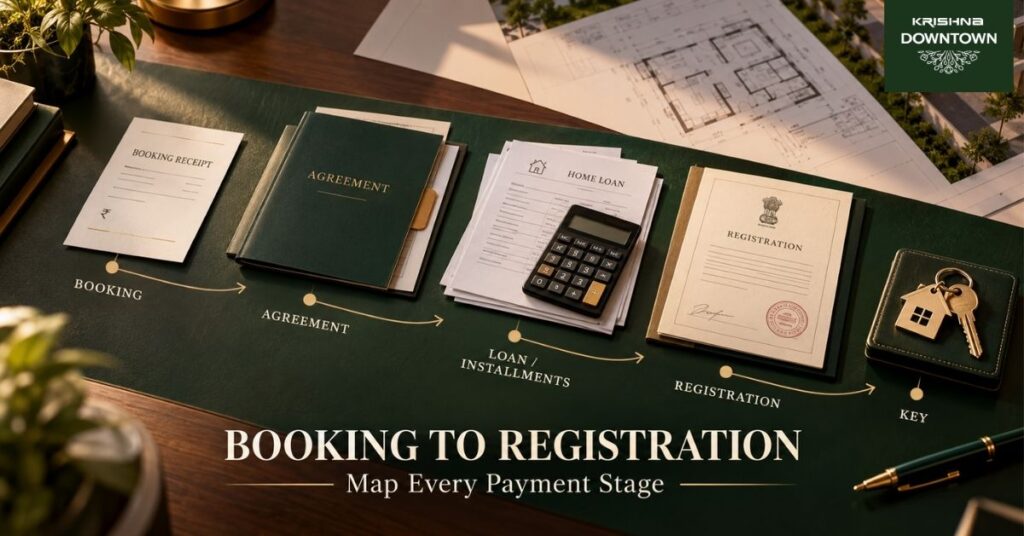
Buying a home is often discussed as one large number: the property price. In real life, however, the money leaves your account in several different stages. A booking amount may come first. Then there can be the agreement for sale, your own contribution, bank disbursements, project-linked instalments, taxes, final settlement, stamp duty and registration charges, and finally the registered transfer.
That is why a buyer who can afford the headline price can still feel financially stretched during the transaction. The real question is not only “Can I afford this home?” It is also: What amount becomes due at each stage, what triggers that payment, and what document should I receive before I pay it?
For families evaluating a villa in Bhubaneswar, a villa in Phulnakhara, or any residential property in Odisha, understanding these home buying payment stages before booking can prevent last-minute surprises and make conversations with the developer, bank and registration office much clearer.
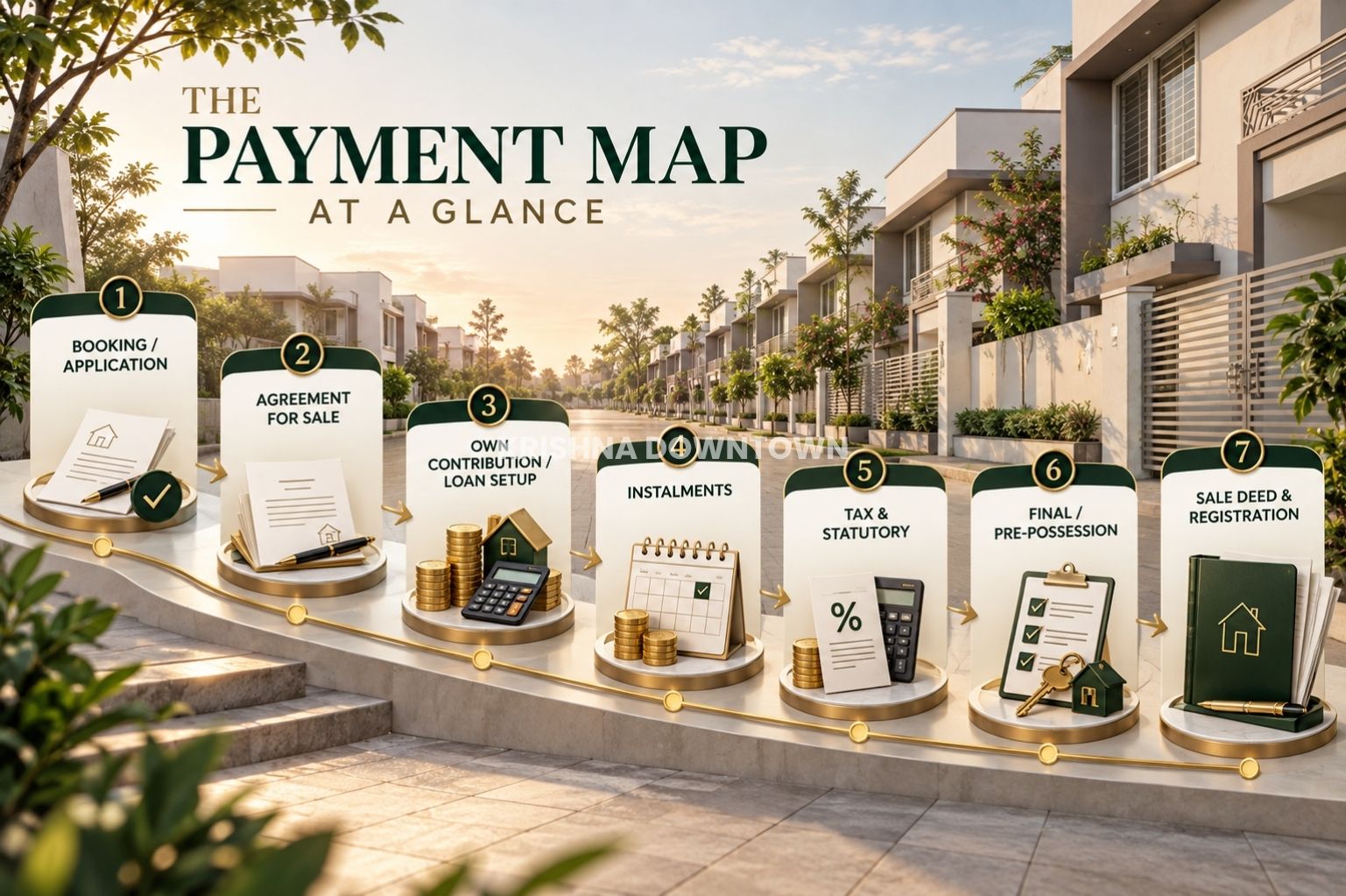
| Quick Answer A typical home buying payment timeline moves from booking → registered agreement for sale → buyer’s own contribution / home-loan setup → agreed instalments or construction-linked demands → applicable taxes and deductions → final settlement → sale deed registration. But there is no universal percentage schedule that applies to every project. Under RERA, a promoter cannot take more than 10% of the property cost as advance/application fee before entering into and registering an Agreement for Sale; after that, the written agreement’s payment plan becomes the key reference. |
| Stage | Trigger | Typical Money Movement | Proof to Keep |
| 1. Booking / application | Unit selection + booking terms | Booking/application amount; pre-AFS collections cannot exceed the RERA limit | Booking form, cost sheet, receipt, refund/cancellation terms |
| 2. Agreement for Sale | Registered AFS is executed | Amount due under agreed schedule + applicable agreement registration/stamp costs | Registered AFS, annexures, payment plan, specifications |
| 3. Own contribution / loan setup | Lender sanction conditions + buyer margin | Buyer’s own funds; processing/legal/technical fees as applicable | Loan sanction letter, lender conditions, receipts |
| 4. Agreed / construction-linked instalments | Date or milestone stated in AFS/payment plan | Instalment less lender disbursement/TDS as applicable | Demand letter, milestone support, lender disbursement advice |
| 5. Tax & statutory checkpoint | Transaction/tax trigger | GST if legally applicable; buyer-side TDS where applicable | Tax invoice, TDS challan/statement, acknowledgements |
| 6. Final / pre-possession demand | Contractual completion/possession milestone | Balance price + only itemised contractual charges | Final demand, account statement, inspection/handover documents |
| 7. Sale deed & registration | Transfer is ready for registration | Stamp duty, registration fee, balance consideration as applicable | Registered sale deed, registration receipt, certified/online records |
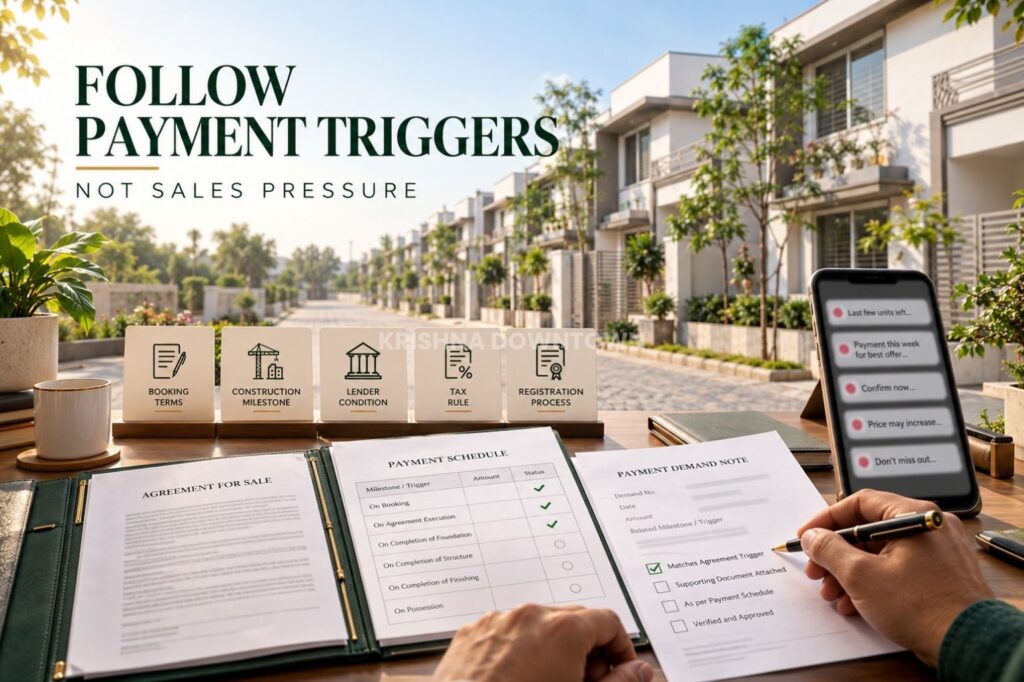
The most useful habit in a property purchase is simple: never treat a payment request as self-explanatory. Every demand should connect to a written trigger—booking terms, the agreement for sale, a construction milestone, a lender condition, a tax rule, or the registration process.
RERA Section 13 is important because it creates the first clear boundary. A promoter cannot accept more than 10% of the cost of the apartment, plot or building as an advance or application fee without first entering into a written and registered agreement for sale. The same provision requires the agreement to specify the dates and manner in which payments are to be made. In other words, after the agreement, your strongest reference is not a WhatsApp message or a verbal promise—it is the signed payment schedule.
| Buyer Principle Before every major transfer, ask four questions: What am I paying? What makes it due now? Where is that trigger written? What proof will I receive after payment? |
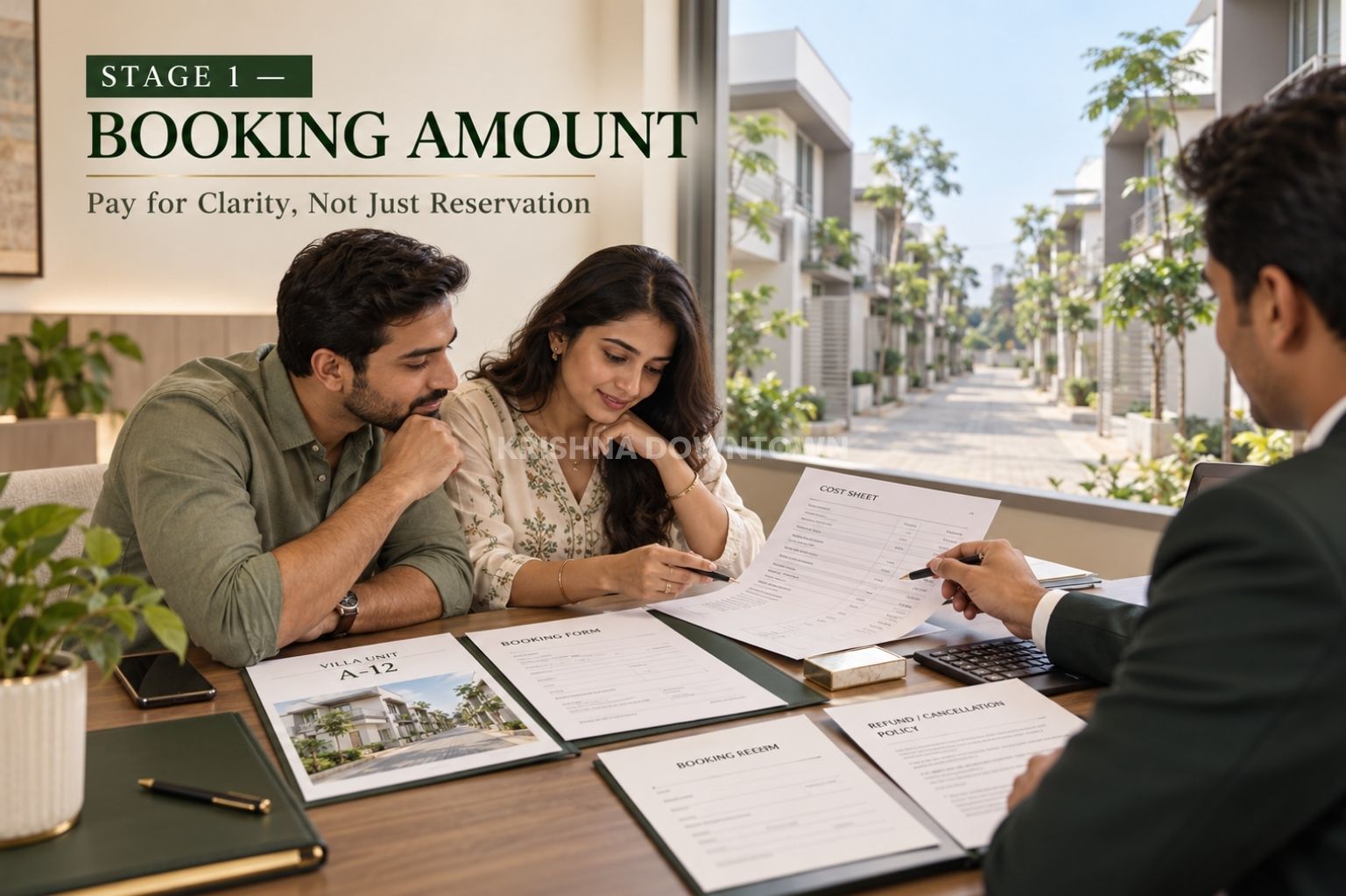
The booking amount for property is usually the first money a buyer pays to reserve a specific unit. But this is also the stage at which buyers often have the least documentation. Before making a booking payment, get the commercial basics in writing.
For a RERA-covered sale, the legal point to remember is not that “booking must always be 10%.” The point is that the promoter cannot cross 10% of the property cost before the registered Agreement for Sale. A project may ask for less. Buyers should therefore treat 10% as a statutory ceiling at that pre-agreement stage, not as a recommended amount.
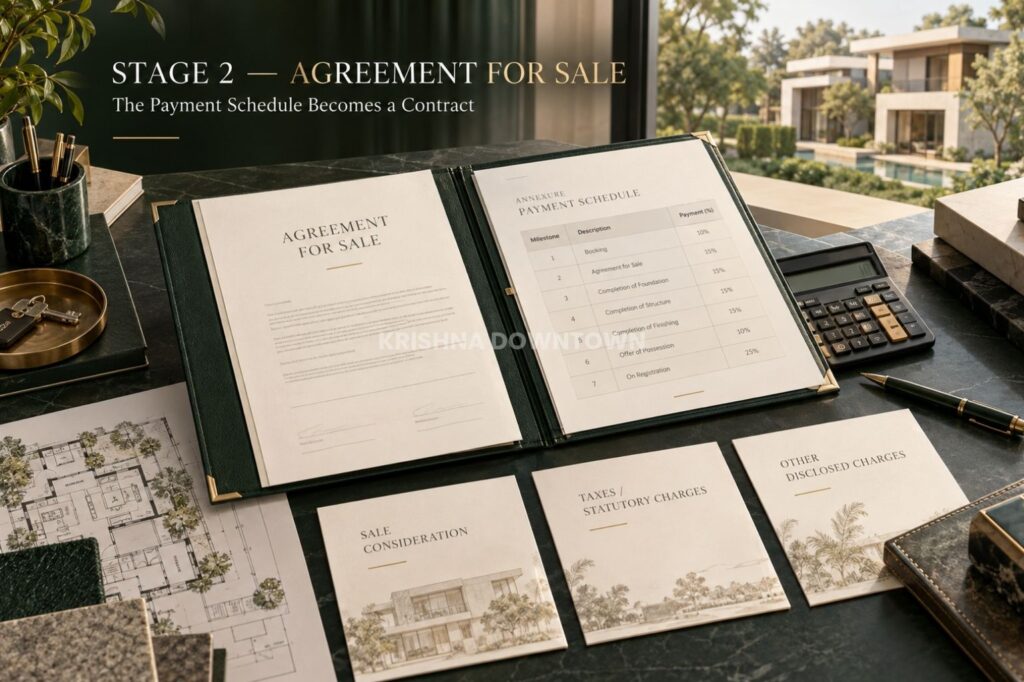
The agreement for sale payment stage is where the transaction becomes much more defined. The agreement should set out the property/unit particulars, price, specifications, development details, possession timeline, default consequences and—critically—the property payment schedule.
Read the payment annexure line by line. Some schedules are date-linked; others are construction-linked; some combine both. Do not assume the percentage pattern used by one project will apply to another. There is no single legally mandated “20:20:20” or “10:80:10” structure for all residential projects.
At this stage, also separate three different buckets in your mind: sale consideration, taxes/statutory charges, and other disclosed charges. A cost sheet that mixes everything into one round number is harder to audit later.
| What to Save Keep the registered Agreement for Sale, every annexure, the approved/committed specifications referenced in it, the payment schedule, the unit plan, receipts, and any signed cost sheet. Your future payment decisions should be reconcilable to these documents. |
If you are financing the purchase, the next stage is not simply “the bank pays.” A lender generally expects the buyer’s required own contribution to be brought in according to its sanction conditions before or alongside disbursement. The exact ratio is lender- and borrower-specific, so avoid assuming that an advertised loan percentage automatically applies to you.
This is where your earlier home loan sanction vs project approval understanding matters. A sanction relates to your borrowing eligibility and loan conditions; property/project legal and technical checks can still affect disbursement. Buyers should therefore align the developer’s due date with the bank’s document and disbursement timeline rather than waiting until the last day.
For an under-construction home, a large part of the price may be paid through a construction linked payment plan. The central discipline is to match the demand to the agreement—not to a generic industry chart.
When a payment demand arrives, verify the unit/account details, amount already paid, amount now demanded, tax treatment, the milestone or date cited, and the due date. Where the demand is milestone-based, ask for reasonable evidence that the relevant stage has been reached. If a home loan is involved, confirm the lender’s inspection or disbursement requirement as well.
A buyer should also maintain a simple ledger with four columns: Date | Demand reason | Amount paid | Receipt/reference number. This small habit makes final account reconciliation dramatically easier.
A property price and the cash needed to complete a property purchase are not always the same number. Taxes and statutory payments can arise at different points, so buyers should create a separate budget bucket instead of discovering them at registration.
Under the GST framework, construction of a residential property intended for sale can be treated as a taxable construction service when consideration is received before the completion-certificate/first-occupation cut-off. By contrast, sale of a building where the entire consideration is received after the relevant completion/first-occupation point falls outside the GST supply scope under Schedule III. The exact tax treatment depends on the project and transaction, so ask for the applicable tax rate, basis and invoice rather than assuming one from another project.
For a purchase from a resident seller, the current Income Tax provisions for immovable property generally require the buyer to deduct 1% TDS when the consideration or stamp-duty value, as applicable under the law, reaches ₹50 lakh or more. The law also treats several incidental charges—such as certain parking, utility or maintenance-related charges—as part of consideration for this purpose. Because filing mechanics and form numbers can change, verify the current process on the Income Tax portal or with a tax professional before making the relevant payment.
| Budget Rule Do not use your entire available cash as the “down payment.” Keep a separate reserve for stamp duty, registration fee, applicable taxes/TDS compliance, lender charges, documented possession-stage charges, interiors and moving costs. |
The final demand is the point where small unexplained line items can suddenly become large in aggregate. Before clearing it, ask for a complete statement of account showing the original consideration, all receipts, taxes, credits, loan disbursements and the exact balance.
Any maintenance deposit, corpus contribution, utility connection amount, meter/security deposit or other charge should be traceable to the contract/cost sheet and clearly itemised. Do not accept a vague “possession charges” total without a breakup.
For a ready or nearly completed villa, this is also the time for a detailed physical inspection. Financial closure should not replace inspection of the actual home, promised specifications, visible defects, access, parking, water/drainage and common facilities relevant to your purchase.
The sale deed registration stage is different from booking and the Agreement for Sale. The registered sale/conveyance instrument is the document through which ownership is transferred, subject to the applicable law and transaction structure.
The Odisha Inspector General of Registration currently lists 5% stamp duty and 2% registration fee for “Sale Immovable.” Its property-registration guidance also notes a 4% stamp duty rate in the case of immovable property purchased by a woman through a sale deed. Because valuation, deed type, concessions and rules can affect the actual amount, buyers should use the official Odisha IGR Stamp Duty & Registration Fee Calculator and confirm the final figures before payment.
At registration, the Odisha IGR process requires property/party information and supporting documentation. The portal lists identity proof for executants/claimants, ownership documents, PAN/Form 60 requirements in specified cases, and encumbrance-related documentation among the items used for registration. Your legal adviser and the registering office should confirm the exact set for your transaction.
Treat stamp duty and registration charges Odisha as part of your pre-planned cash flow—not as an amount to arrange after the rest of your savings have already been committed.
After the deed is registered, preserve the registered instrument and registration acknowledgement carefully. Reconcile the developer/seller ledger to ensure there is no unexplained balance. Where relevant, coordinate mutation/RoR follow-up, lender document custody, insurance, utility transfer and association/maintenance onboarding.
A good transaction file should let you answer a simple question years later: How much did I pay, to whom, for what reason, under which document, and where is the receipt?
| Payment Bucket | Planned Amount | Trigger / Date | Proof to File |
| Booking/application | ₹ ______ | Date ______ | Receipt / booking form |
| Agreement for Sale stage | ₹ ______ | Date ______ | Registered AFS + receipt |
| Own contribution | ₹ ______ | Date(s) ______ | Bank proof / developer receipt |
| Loan disbursement 1 | ₹ ______ | Date ______ | Bank advice + receipt |
| Subsequent instalment(s) | ₹ ______ | Milestone/date ______ | Demand + receipt |
| GST / tax as applicable | ₹ ______ | Trigger ______ | Tax invoice / acknowledgement |
| Property TDS as applicable | ₹ ______ | Payment date ______ | TDS filing/payment proof |
| Final/pre-possession settlement | ₹ ______ | Date ______ | Final statement + receipt |
| Stamp duty | ₹ ______ | Registration date ______ | Government payment receipt |
| Registration fee | ₹ ______ | Registration date ______ | Government payment receipt |
| Post-registration / moving reserve | ₹ ______ | Month ______ | Personal budget |
For buyers exploring Krishna Downtown, Phulnakhara, the official project website currently positions the development as a gated community offering 3 BHK and 4 BHK villas in Phulnakhara near Bhubaneswar. Instead of relying on a generic payment example from another project, ask the sales team for the current unit-specific cost sheet, booking terms, Agreement for Sale/payment schedule, applicable tax breakup, lender process, current registration assumptions and any possession-stage charges.
This is especially important because a payment plan can vary by unit, phase, construction status, offer and financing arrangement. The most trustworthy conversation is therefore not “What percentage do all buyers pay?” but “Show me the written payment map for this exact villa, and explain what triggers every stage.”
| Site-Visit CTA If you are comparing a villa near Bhubaneswar, carry this payment checklist to the site visit. Ask for the current written cost sheet first, then map every payment against the Agreement for Sale, loan process and registration budget before making a commitment. |
A homebuyer does not usually pay for a property in one clean transaction. The purchase unfolds through home buying payment stages, and every stage has a different purpose. Booking reserves the unit. The Agreement for Sale defines the promises and payment schedule. Your own contribution and lender disbursements fund the purchase. Agreed instalments move with time or construction. Taxes and statutory deductions need separate planning. The final settlement closes the commercial account. And property registration in Odisha completes the legal transfer through the registered deed.
The safest way to manage this journey is to make every payment answerable to a trigger and every trigger answerable to a document. That habit does more than prevent surprises—it gives you a transaction record you can understand, verify and defend.
For families considering Krishna Downtown, Phulnakhara, the next practical step is to review the current villa-specific cost sheet and payment schedule, verify the documentation relevant to the unit and phase, and then plan the purchase around your real cash flow—not only the headline price.
Under Section 13 of RERA, a promoter cannot accept more than 10% of the cost of the apartment, plot or building as an advance or application fee without first entering into and registering a written Agreement for Sale.
No. There is no universal percentage schedule for every project. The property payment schedule should be read from the written Agreement for Sale and related cost-sheet documents.
Disbursement depends on the lender’s sanction conditions, property/project verification, buyer contribution and the payment/demand schedule. Under-construction purchases may involve stage-wise disbursement.
No. GST treatment depends on the transaction and construction/completion status. CBIC rules distinguish construction service sold before the relevant completion/first-occupation point from sale of a building after that point. Buyers should obtain a documented tax calculation for their transaction.
For purchase from a resident seller, the current income-tax provisions generally require 1% TDS when the consideration or stamp-duty value reaches ₹50 lakh or more, subject to the detailed statutory conditions.
The Odisha IGR portal currently lists 5% stamp duty and 2% registration fee for Sale Immovable, and notes 4% stamp duty for immovable property purchased by a woman through sale deed. Use the official calculator and verify your exact deed/value before payment.

Book a Personalized site visit to explore premium villas in Phulnakhara near Bhubaneswar
No Spam, We will only reach out for visit scheduling