

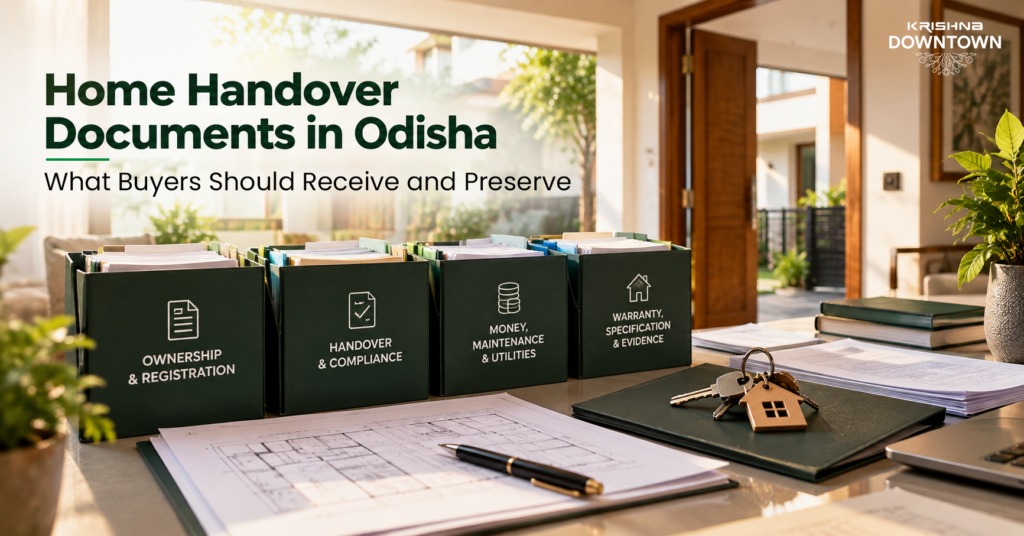
There is a moment on possession day when the keys finally land in your hand and the paperwork suddenly feels secondary. That is exactly when buyers should become more careful.
A home is not fully handed over because the door opens. A clean handover also needs a document trail that proves what you bought, what was paid, what was approved, what was delivered, what is covered by warranty, and what remains the responsibility of the developer or association.
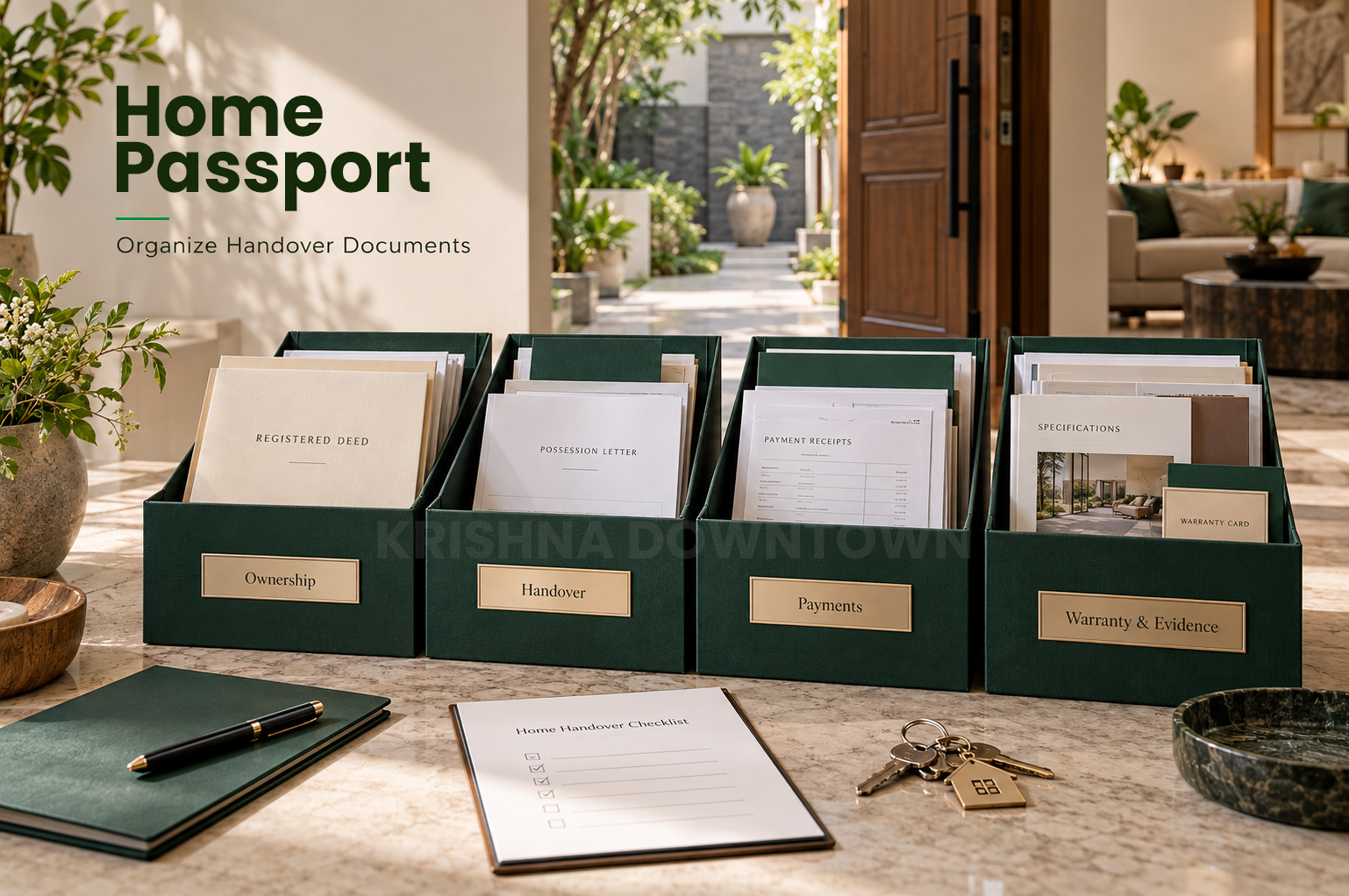
For a buyer taking possession of a villa or home in Bhubaneswar, Phulnakhara or elsewhere in Odisha, the safest approach is not to chase a random internet list of “20 documents.” Instead, build a simple Home Passport – four organised folders that can still make sense five or ten years later when you refinance, sell, mutate records, claim a defect, replace equipment, or answer a buyer’s lawyer.
| Quick Answer At handover, preserve four categories of records: (1) ownership and registration, (2) possession and compliance, (3) payments, maintenance and utilities, and (4) warranties, specifications and evidence. Under RERA, promoters must obtain and make available the completion certificate or occupancy certificate, or both, as applicable, and allottees are entitled to relevant sanctioned plans, specifications and necessary documents. Some project/common-area documents, however, are intended for the association of allottees or competent authority, not necessarily as originals for every individual buyer. |
A stack of papers is not a system. The buyer-friendly way to manage home handover documents in Odisha is to sort them by the question they answer:
• Can I prove ownership? – deed, agreement, allotment and registration trail.
• Can I prove lawful completion / possession status? – handover letter, applicable completion/occupancy records, approved plans and specifications.
• Can I prove what I paid and what is still chargeable? – final account, receipts, maintenance deposits and utility records.
• Can I prove what was installed, promised and accepted? – warranties, manuals, finish schedule, snag closure and photographs.
This matters because the same property document may be useful in very different situations. A registered sale deed supports title; a possession letter records physical handover; an occupancy certificate, where applicable, addresses occupancy compliance; a warranty card helps with a failed pump or fixture. Treating them as interchangeable creates problems later.
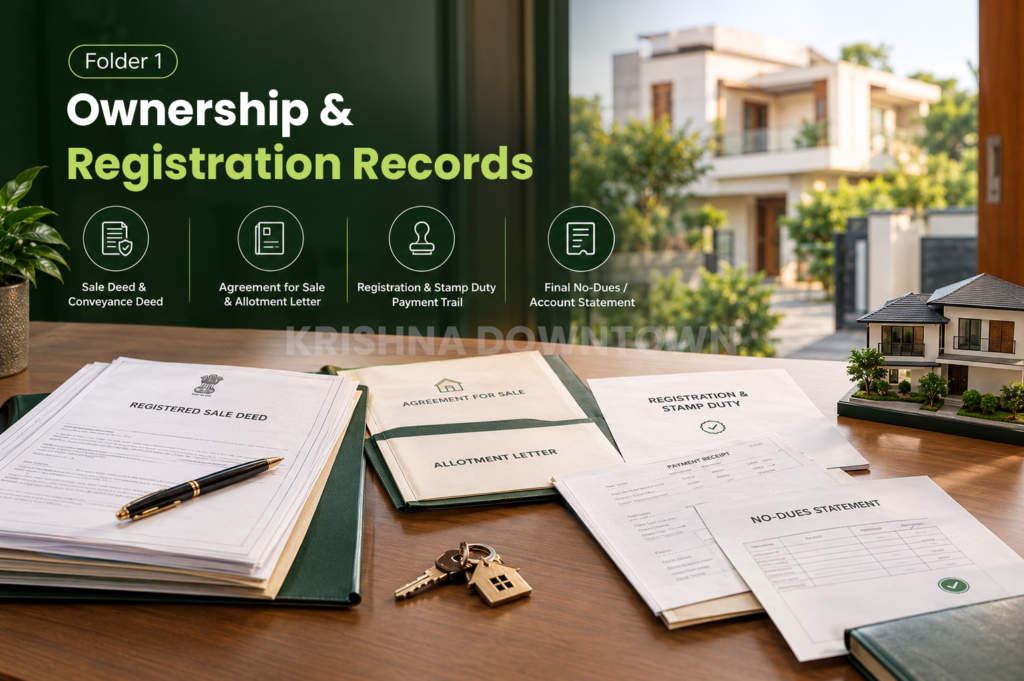
The registered sale deed in Odisha is one of the most important records in your Home Passport. Odisha IGR explains that after registration, the registered deed can be handed to the applicant or downloaded from the IGR portal using the application trail. Keep the registered version securely – not merely the draft that was circulated before execution.
Verify the buyer and seller names, property description, plot/khata details where relevant, consideration, boundaries/schedule, execution details and registration endorsement. If a home loan lender keeps the original as security, maintain a document-custody record showing exactly which original was deposited with the bank and retain the bank’s acknowledgement.
Do not discard the agreement for sale merely because the sale deed is registered. It remains useful for checking specifications, promised amenities, possession terms, payment milestones, defect clauses and other obligations that may not be repeated in the final conveyance deed. Preserve the allotment letter as part of the transaction chronology as well.
Retain the registration application/reference details, stamp-duty and registration-fee payment evidence, and any final registration receipt or endorsement available from the Odisha IGR process. These records make later verification much easier if you need a certified copy, respond to a bank query, or reconcile your transaction file.
Ask for a written final account statement or no-dues confirmation that clearly shows what has been received and whether any amount remains pending. If maintenance, utility deposits, corpus/sinking contributions or documentation charges are separate, they should be identifiable rather than buried inside one unexplained number.
E. Possession / handover letter
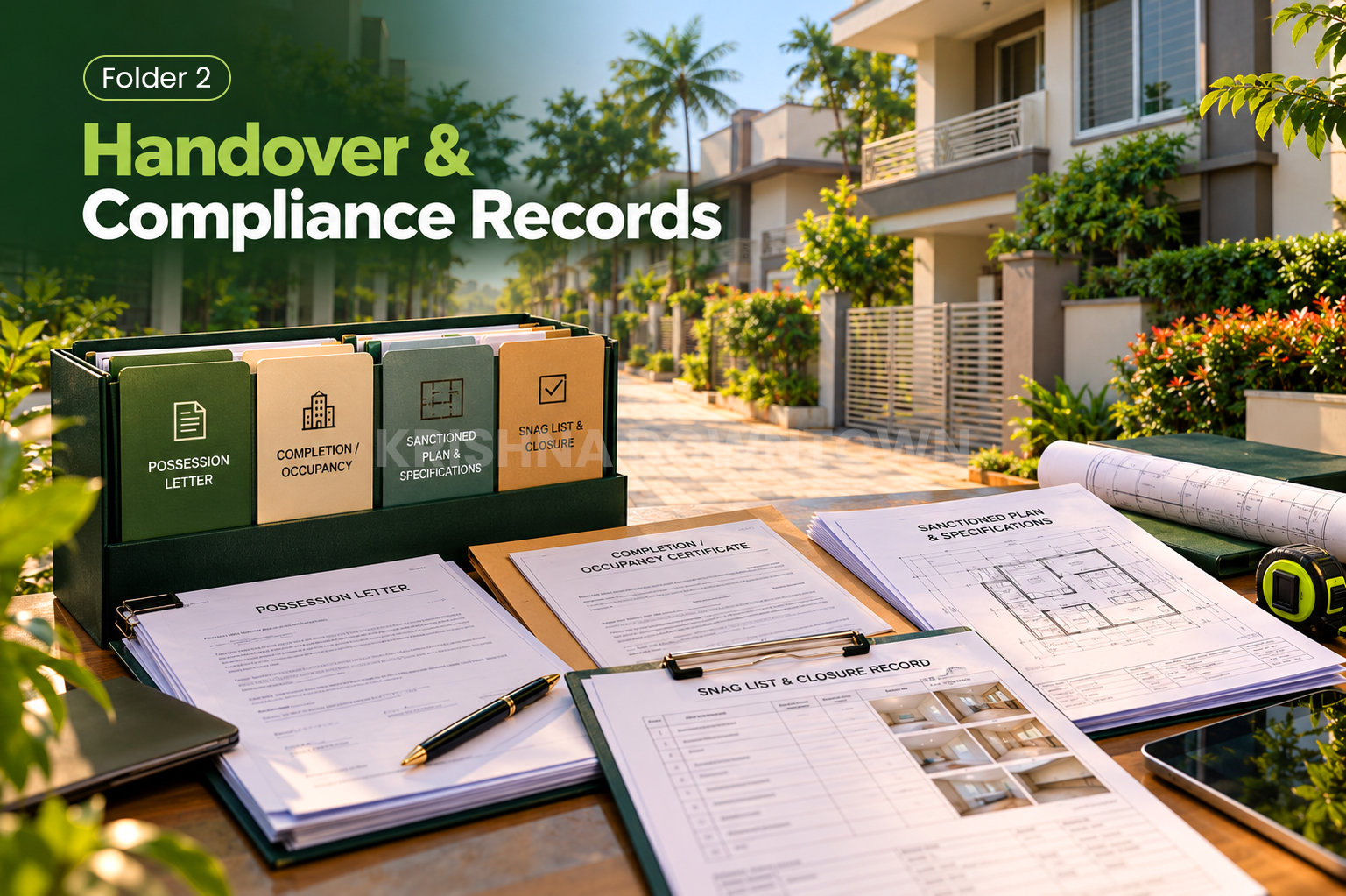
The possession letter or handover memo should identify the home being handed over and record the handover date. Read every declaration before signing. If defects or documents remain pending, attach or reference a written pending-item list instead of signing an acknowledgement that suggests everything has been received when it has not.
F. Completion Certificate / Occupancy Certificate – as applicable
This is an area where buyers should avoid both complacency and overstatement. Section 11(4)(b) of RERA says the promoter is responsible for obtaining the completion certificate or occupancy certificate, or both, as applicable, from the competent authority under local law and making it available to allottees individually or to their association.
So the practical question is not “Does every project always have both papers in the exact same format?” It is: Which completion/occupancy approval applies to this phase, building or villa under the competent local authority, and can I verify it? Ask for the relevant certificate/reference and verify the phase or unit it covers.
G. Sanctioned plan, layout and agreed specifications
RERA gives allottees the right to information relating to sanctioned plans, layout plans and approved specifications. Preserve the version relevant to your purchase, plus any formally approved change that affects your home. This becomes especially valuable if a future buyer, architect, lender or lawyer asks what was originally sanctioned or promised.
H. Snag list and closure record
Your earlier villa possession inspection may identify defects, incomplete finishes or functional issues. Do not let that evidence disappear after repairs. Keep the original snag list, dated photographs, developer acknowledgement, repair commitment and closure confirmation. A “fixed” item with no paper trail is much harder to establish later.
I. Payment receipts and tax-related transaction records
Preserve booking receipts, milestone receipts, final payment evidence and any tax-related transaction documents applicable to your purchase. These form the financial chronology of the home and can help during loan reconciliation, tax review, resale or a dispute over whether a charge was already paid.
J. Maintenance terms, deposit receipt and handover statement
A gated community has costs beyond the private home. Preserve the maintenance agreement / terms, maintenance or corpus deposit receipt, billing start date, rate basis, services covered, escalation method if stated, and the contact details of the facility/maintenance agency.
If the maintenance responsibility is later transferred to an association, keep the transition communication. This helps separate what was a developer obligation from what became a community obligation.
K. Electricity, water and other utility handover records
Record meter numbers, meter readings on handover date, consumer/account IDs if assigned, connection status and deposit receipts. For any supplied equipment – pump, inverter, solar component, water-treatment system or similar – note the model/serial number and responsible service contact.
L. Warranty cards, manuals and vendor contacts
If the developer supplies branded fixtures, pumps, sanitaryware, electrical equipment, appliances or systems, collect the warranty cards, invoices where provided, manuals and authorised-service details. Photograph serial numbers before labels fade or equipment becomes difficult to access.
M. Finish and specification sheet
A simple finish schedule can save surprising amounts of time later. Record tile series, paint shade/code, sanitaryware model, CP fitting model, electrical switch range, door hardware and other key specifications supplied with the home. This is more useful than trying to identify an exact shade or model several years later.
N. Key / access inventory
Keep a signed or dated inventory for main-door keys, internal keys, gate remotes, mailbox keys, utility-room access, cards/tags and any digital access credentials. This sounds minor until a future lock replacement or access dispute arises.
O. Handover-day photo and video record
Take a structured photo/video set on handover day: each room, meter readings, external elevations, terrace/balcony areas, driveway/parking, boundary/plot interface, installed equipment and every unresolved snag. Store the files with date-based names, not only inside a WhatsApp chat that may disappear.
This distinction is one of the most overlooked parts of a property handover checklist in Odisha.
RERA Section 17 requires the promoter, after the applicable completion/occupancy stage and physical possession, to hand over necessary documents and plans including common-area material to the association of allottees or competent authority, as local law requires. Section 16 similarly deals with project insurance documents being handed to the association on formation.
That means an individual buyer should not assume that every common-area title document, insurance record, engineering drawing or original approval will be placed in their personal file. What you should do is confirm:
Do not measure document completeness only by the thickness of your folder. Measure it by status and custody.
| Document | Preferred form | Typical custody | Buyer action |
| Registered sale deed / conveyance deed | Original / registered digital record | Buyer or lender if mortgaged | Keep lender acknowledgement if original is deposited. |
| Agreement for sale | Signed original / registered copy as applicable | Buyer | Preserve with annexures and specifications. |
| Possession / handover letter | Signed original or authenticated copy | Buyer | Ensure pending items are recorded. |
| Completion / occupancy approval | Verifiable copy/reference as applicable | Buyer / association / project record | Verify authority, phase/building/unit coverage. |
| Sanctioned plan / layout / specifications | Approved copy/reference | Buyer + project/association records | Keep the version relevant to your purchase. |
| Payment / no-dues statement | Signed or system-generated record | Buyer | Preserve final reconciliation. |
| Common-area plans / project insurance records | Project-level originals or records | Association / competent authority | Confirm association handover rather than demanding every original personally. |
| Warranty / manuals | Original or digital | Buyer | Store serial/model numbers. |
For buyers in Odisha, the registration system itself creates a useful post-registration trail. The Odisha IGR portal states that after a sale deed is registered, a digitised Form-3 is transmitted to the relevant Tahasil office to initiate mutation and correction of the Record of Rights (RoR) through the e-Mutation workflow.
So your Home Passport should eventually include, where applicable to your property and transaction:
Mutation/RoR updates do not replace the registered conveyance deed. They are part of keeping the revenue/administrative record aligned with the transaction. If your villa transaction has a different land/title structure, take project-specific legal advice on the applicable record updates.
A pending document should never remain a vague verbal promise. Use a simple Pending Document Log.
| Document / record | Status | Owner | Due date | Evidence |
| Example: applicable occupancy/completion approval | Copy pending | Developer/project team | [date] | Email / letter ref. |
| Example: snag closure sheet | 2 items open | Site team | [date] | Photo IDs 07, 11 |
| Example: utility consumer ID | Activation pending | Utility / project | [date] | Application ref. |
If the pending item is material to title, lawful occupation, project approval, payment liability or another legal right, do not rely only on this article or a verbal assurance. Have the relevant document and your agreement reviewed by a qualified property lawyer before signing a broad “full and final” acknowledgement.
| Buyer rule: never sign faster than you can read If the handover form says you have received “all documents,” “all approvals,” or the home “without objection,” but something is actually pending, ask for the pending item to be recorded in writing or for the acknowledgement to be corrected before signing. |
The official Krishna Downtown website positions the project as a 3/4 BHK gated villa community in Phulnakhara near Bhubaneswar and Cuttack, with earlier phases sold out and family-oriented planning. For a buyer approaching handover, the useful next step is not to rely on a generic checklist alone.
Ask the Krishna Properties and Developer team for a phase- and villa-specific handover document list before the possession appointment. Cross-check that list against your own agreement, payment records, applicable ORERA disclosures, registered deed status and the four-folder Home Passport above.
Project facts, approvals and handover documents can differ by phase and transaction. Verify the current documents for your specific villa instead of assuming that a document shown for another phase automatically applies to yours.
Create both a physical archive and a digital archive. The goal is not only storage; it is retrievability.
Physical file
• Use four labelled sections: Ownership, Compliance/Handover, Money/Utilities, Warranty/Evidence.
• Keep originals in acid-free sleeves; do not staple or laminate important originals unless advised.
• Store in a dry, secure place; keep sensitive originals away from routine household paperwork.
Digital file
• Scan every core document clearly in PDF, including annexures and endorsement pages.
• Use filenames such as `01_Registered_Sale_Deed_YYYY-MM-DD.pdf` rather than `scan001.pdf`.
• Keep at least two secure backups, with one off-device/cloud copy under your control.
• Export important email confirmations and do not rely only on chat screenshots.
Custody register
If any original is held by a bank, lawyer, association or another authorised party, maintain a one-page Original Document Custody Register with the document name, holder, date handed over, acknowledgement number and expected return/release condition.
The best possession day is not the one that ends fastest. It is the one that leaves the buyer with a clear, verifiable record of ownership, compliance, payments, handover status and future responsibilities.
For families buying a villa in Phulnakhara or a home near Bhubaneswar, the practical standard is simple: know what belongs in your personal file, know what belongs with the association, know where every original is, and put every pending item in writing.
That discipline may feel administrative on day one. Years later – during resale, refinancing, mutation, warranty work or a legal query – it becomes one of the most valuable parts of the purchase.
| Soft CTA – Krishna Downtown If you are approaching possession at Krishna Downtown, Phulnakhara, ask the project team for the current phase-specific handover-document checklist before your appointment. Compare it with your agreement and this Home Passport, and clarify any pending item in writing before closing the handover. |
At minimum, preserve your registered sale deed or conveyance deed, agreement for sale and allotment records, possession/handover letter, applicable completion/occupancy approval, final payment/no-dues trail, relevant plans/specifications, maintenance and utility records, and warranties. Some project/common-area records may be held by the association rather than individually.
No. A possession letter records physical handover, while the registered sale deed / conveyance deed is central to the legal transfer of title. Both should be preserved because they serve different purposes.
Yes. Keep it with its annexures because it may contain specifications, payment terms, possession commitments, amenity obligations and other contractual details that remain useful after registration.
Not necessarily. RERA distinguishes between information/documents available to allottees and project/common-area records that may be handed to the association of allottees or competent authority. Confirm who holds the original and how you can inspect or obtain an authenticated copy if needed.
Maintain a written original-document custody register and the lender’s acknowledgement listing the originals held. Keep scanned copies and your loan/security records until the originals are formally released.
Core ownership, registration, approval and title-related records should be treated as long-term or permanent property records while you own the home. Keep loan-closure, tax, mutation, warranty and maintenance records for their relevant lifecycle as well. For a specific retention question, consult your lawyer or tax adviser.

Book a Personalized site visit to explore premium villas in Phulnakhara near Bhubaneswar

No Spam, We will only reach out for visit scheduling