

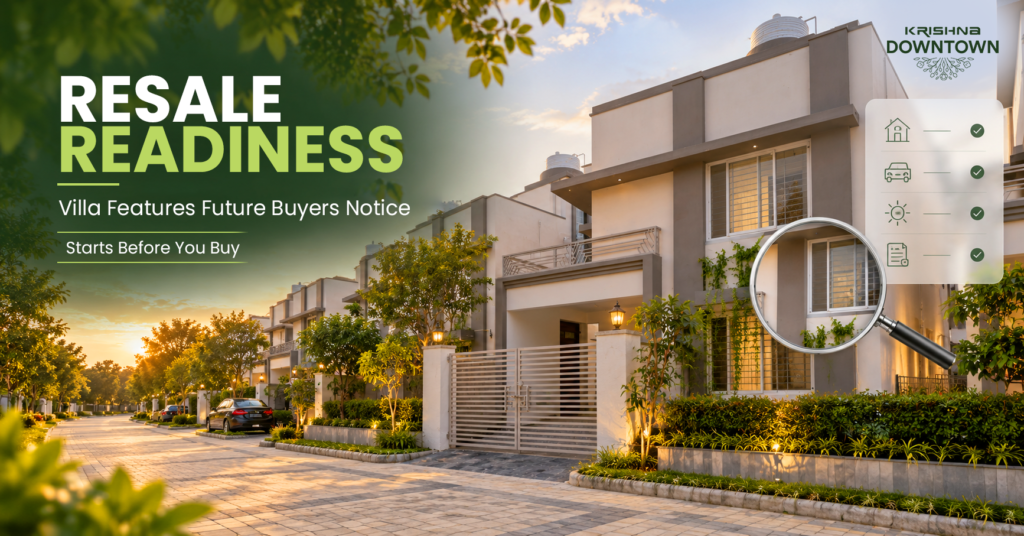
Most people think about resale only when they are ready to sell. By then, however, many of the decisions that shape villa resale value were made years earlier—when the home was first shortlisted.
That does not mean you should buy a home for an imaginary future owner. Your family still comes first. But there is a useful middle ground: choose a villa that fits your life without creating unnecessary friction for the next buyer. A practical layout, usable parking, sensible room proportions, manageable upkeep, healthy light and air, clean documentation and a well-kept community are valuable today and they are also easier for a future buyer to understand.
This distinction matters for anyone comparing a villa in Bhubaneswar or a villa in Phulnakhara. Resale readiness is not a promise that prices will rise, nor is it a guarantee that a home will sell quickly. Market conditions, supply, financing, location demand and the asking price at the time of sale will all matter. What you can influence today is whether your villa presents the next buyer with a long list of compromises—or a short one.
| Quick answer A resale-ready villa usually has broad everyday usability: a location that works in real life, comfortable parking, adaptable rooms, good light and ventilation, easy-to-maintain materials, usable outdoor space, reasonable recurring costs, a presentable community and an organised document trail. These features do not guarantee appreciation; they reduce reasons for future buyers to walk away or negotiate aggressively. |
Searches for property resale value often mix three different questions: “Will this location appreciate?”, “What will my home be worth?”, and “Will another buyer actually want this property?” They are not the same.
Appreciation is a market outcome. It can be influenced by wider demand, infrastructure, credit conditions, new supply and local pricing. Resale readiness, by contrast, is a property-quality question: how easily can a future buyer understand the home, verify it, imagine living there and accept its compromises?
That is why a home with expensive finishes can still be awkward to resell, while a simpler villa with better parking, stronger daylight, a flexible room plan and clear paperwork may appeal to a wider set of families. Current resale guidance in India repeatedly points to practical layout, natural light, ventilation, parking, maintenance and clean documents as factors buyers notice—not just decorative upgrades.
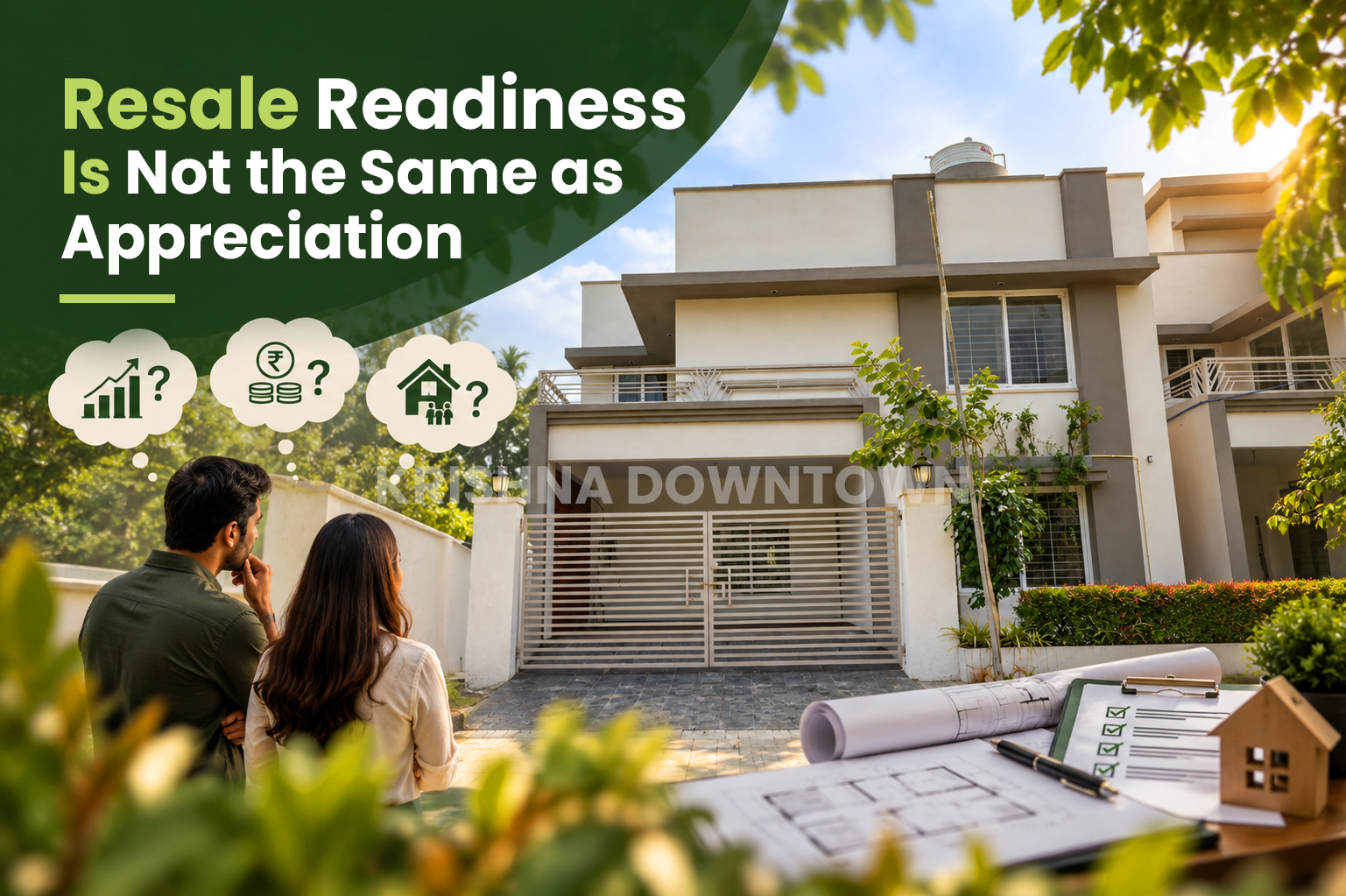
During your next site visit, do not ask only, “Do I like this villa?” Add five future-facing questions:
| Core principle Future buyers rarely pay extra because a home was difficult to explain. Resale readiness improves when the home needs fewer explanations, fewer exceptions and fewer immediate fixes. |
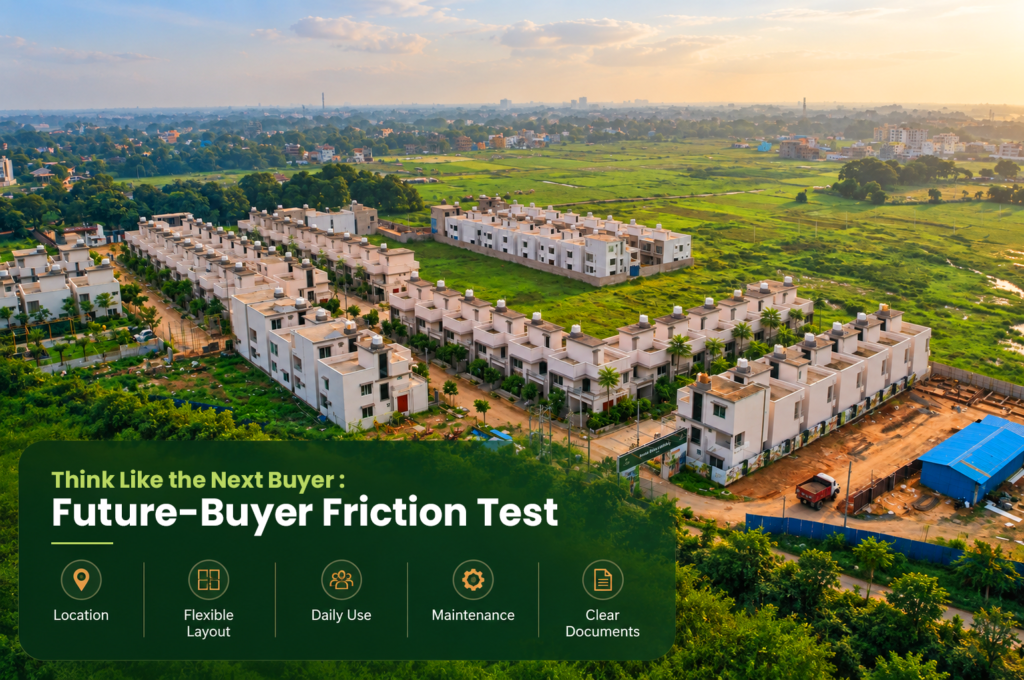
A resale buyer starts forming an opinion before stepping into the living room. These first few minutes can decide whether the rest of the visit feels promising or defensive.
Location is still one of the strongest factors affecting property resale value, but “good location” should be tested through everyday behaviour. Can a family reach the road network, schools, healthcare, shopping and work routes without depending entirely on a future project or proposed shortcut?
For a villa near Bhubaneswar, a future buyer may value Twin City access differently from you. One family may work in Bhubaneswar, another may have business or relatives in Cuttack. A location that serves more than one routine can widen the buyer pool. However, avoid assuming that development automatically guarantees appreciation. Visit the route, observe peak-hour conditions and separate existing connectivity from proposed infrastructure.
A future buyer does not experience “location” as a pin on Google Maps. They experience the final kilometre. Narrow approaches, awkward turns, damaged roads, waterlogging or a difficult gate transition can become immediate negotiation points.
Inside a gated villa community, road width matters—but usable movement matters more. Can two vehicles pass comfortably? Can guests stop without blocking another home? Can an emergency vehicle approach? A well-planned internal road network supports daily life and makes the community feel organised years after launch.
Parking is one of the easiest resale features to underestimate because the space may look generous when it is empty. A future buyer sees the gate width, turning geometry, ability to open doors, independent exit, scooter/cycle space and the walking route from car to home.
This is why villa resale value is better protected by functional parking than by a brochure label such as “two-car parking.” Use your actual vehicle dimensions during the site visit. If parking requires daily rearrangement, that friction will be just as visible to the next family.
A room can meet a square-footage target and still be difficult to furnish. Future buyers notice whether a queen/king bed fits with side circulation, whether a dining table blocks movement, whether the living room has a usable TV wall, and whether doors collide with furniture zones.
This is where your earlier carpet area vs built-up area checks become important. Resale buyers ultimately react to usable space, not only the number printed in a brochure. Odd corners, long wasted passages and oversized stair lobbies can make a larger villa feel smaller than a better-planned one.
One of the strongest resale-readiness features is not a luxury room—it is an adaptable room. A ground-floor room that can function as a parent’s bedroom, guest room, work-from-home space, study or recovery room gives future families options.
The key is flexibility without permanent over-customisation. A built-in home theatre, platform bed or highly specialised hobby room may suit your household perfectly, but if reversing it requires demolition, the next buyer may price that work into the offer.
Bright photographs can make almost any home look appealing. A resale buyer visiting at 2 PM or after rain will notice the lived reality: dark internal zones, trapped heat, poor air movement, glare, damp corners and windows that cannot remain open without losing privacy.
This matters particularly in Bhubaneswar because BEE classifies the city as warm-humid. For a villa, daylight and natural ventilation are therefore not only aesthetic features; they can influence daily comfort and how dependent rooms feel on artificial lighting and mechanical cooling. Your sunlight and ventilation audit should be repeated with future resale in mind: can a new buyer immediately feel that the house breathes well?
Future buyers often spend more time in the kitchen than sellers expect. They look at refrigerator location, counter continuity, dry/wet utility, washing-machine position, cylinder/service access, ventilation and storage. A beautiful kitchen that has nowhere for cleaning supplies, bulk groceries or appliances creates visible friction.
Storage matters beyond the kitchen too. A linen cabinet, under-stair storage, utility cupboard or sensible wardrobe wall can make a home easier to live in without consuming extra rooms. In resale, these quiet planning decisions often feel more valuable than decorative surfaces.
A future buyer knows that bathrooms can become expensive trouble zones. Stains, loose fittings, weak drainage, poor exhaust, patched waterproofing or inconsistent water pressure can quickly shift the conversation from “I like the house” to “How much will I need to repair?”
When buying new, inspect slopes, drainage points, access panels, plumbing routes and ventilation—not only sanitaryware brands. Good specification and handover records also help later because they make repairs easier to understand.
Villa buyers often value the idea of “land,” but future buyers will ask what they can actually do with it. Is the setback usable for a garden, seating, children, pets or service access? Or is it a narrow leftover strip with poor drainage and no privacy?
A modest but usable outdoor area can feel more valuable than a larger awkward one. Check sunlight, water flow, neighbour sightlines, AC outdoor-unit placement and maintenance access. For resale value of a villa, usability matters more than simply having open space on paper.
Resale buyers inspect the neighbourhood as closely as the house. Faded common areas, damaged internal roads, neglected landscaping, unreliable lighting or visibly deferred maintenance can reduce confidence—even when the individual villa is spotless.
This is why your villa maintenance cost review is also a resale-readiness exercise. The question is not “Are maintenance charges low?” but “Is there a credible system to keep the community functional and presentable?” A realistic maintenance structure can support long-term usability better than an artificially low quote that leaves essential work unfunded.
Privacy is a major reason families choose villas, but total isolation is not the goal. Future buyers may notice direct window-to-window views, overlooking balconies, shared-wall noise, gate visibility and whether outdoor seating feels exposed.
At the same time, the community should not feel disconnected from pedestrian activity or common spaces. The best balance is usually a home that provides personal privacy while still belonging to a functioning neighbourhood.
EV charging readiness, solar feasibility, fibre connectivity, adequate electrical capacity and service routes can improve long-term usability. But a villa does not become resale-ready merely by filling it with proprietary smart-home devices.
Future buyers may prefer systems they can maintain, replace or upgrade locally. Ask whether key services have accessible conduits, spare capacity or practical provision. Future-ready should mean adaptable—not dependent on one discontinued app or vendor.
Colour is easy to repaint. Structural alterations are not. Before removing a bedroom wall, permanently enclosing an outdoor space, building a fixed stage, changing wet-area positions or covering service access, ask whether the alteration helps only your family or still makes sense to a broader buyer.
There is nothing wrong with personalising your home. The resale-aware approach is to make highly personal choices reversible where possible.
A future resale involves more than a site visit. Buyers, lawyers and lenders may review the sale deed, sanctioned/approved records, possession or completion documents as applicable, tax/payment records, maintenance dues, warranties and alterations.
Keep your home handover documents as a permanent “home passport,” not as scattered WhatsApp files. If the project falls under RERA, the next buyer can also cross-check relevant registered-project information through ORERA. Clean records do not guarantee a sale, but they reduce uncertainty during due diligence.
Even a strong home can become difficult to resell if the asking price is disconnected from comparable transactions and current buyer demand. Odisha IGR publishes benchmark valuation tools and transaction-value references for registration purposes, but buyers should not confuse those figures with an automatic open-market selling price.
At resale, compare genuinely similar properties: same micro-market, similar plot/built-up area, age, parking, condition, community and documentation. Asking prices on portals are useful context, but closed transactions and bank/valuer inputs may tell a different story.
You do not need to predict the property market to use this method. During the site visit, walk the villa as if you were seeing it for the first time five years from now.
| Time | Future-Buyer Check |
| 0–3 min: Arrival | Approach road, gate, waterlogging signs, internal movement, street condition, exterior first impression. |
| 3–6 min: Parking & entry | Park real vehicles, open doors, test gate clearance, walk from car to main door, check visitor friction. |
| 6–11 min: Layout | Furniture fit, ground-floor flexibility, privacy, staircase, storage, kitchen/utility workflow. |
| 11–14 min: Light & air | Switch off lights/fans, open windows, look for cross-ventilation, glare, heat and dark internal pockets. |
| 14–17 min: Wet/service areas | Bathrooms, drainage, utility, service access, AC/outdoor units, electrical/EV/solar readiness. |
| 17–20 min: Community & proof | Internal roads, landscaping, maintenance signs, document availability, specification sheet and handover trail. |
| The simplest final question If you had to explain this villa to another practical family in one minute, what would you say are its five strongest everyday advantages—and what are the three compromises you would have to explain away? The fewer serious compromises you must defend, the stronger the resale readiness. |
The official Krishna Downtown website positions the project as a gated 3 BHK and 4 BHK villa community in Phulnakhara and highlights 40-ft internal roads. For a resale-readiness evaluation, do not treat these as marketing lines alone—test how the community works in person.
This approach keeps the site visit useful whether you plan to live in the villa for five years, fifteen years or indefinitely. You are not buying for a future stranger. You are simply avoiding choices that solve today’s needs by creating tomorrow’s unnecessary friction.
A home should first work for the people who will live in it. Resale readiness should never push you into a bland, impersonal house or make you choose a layout your family dislikes.
The smarter principle is narrower: prioritise features that are valuable to many kinds of families, and be cautious with compromises that are expensive, permanent or difficult to explain. Functional parking, adaptable rooms, healthy light and air, usable outdoor space, maintainable systems, a cared-for community and clean documents all improve your experience today while keeping the home easier for a future buyer to evaluate.
When comparing a villa in Phulnakhara or any villa near Bhubaneswar, do not ask only, “Could we live here?” Ask one more question: “If our plans change, would another family understand why this home works?” That is the practical meaning of resale readiness.
| Soft CTA If you are evaluating Krishna Downtown, Phulnakhara, use this Future-Buyer Friction Test during your site visit. Compare the exact villa, its parking, layout, light, service spaces, community condition and documentation before you decide—not a generic resale promise. |
There is no single feature that guarantees villa resale value. Future buyers commonly notice location and access, practical layout, parking, natural light and ventilation, property condition, maintenance burden, community upkeep and clean documentation. Market conditions and the asking price at the time of sale also matter.
No. A larger villa can still have wasted circulation, difficult parking, oversized maintenance needs or awkward room proportions. A slightly smaller home with a practical layout and broad family usability may be easier for future buyers to understand.
A gated format can appeal to buyers who value security, internal roads and common amenities, but the community must remain well managed. Poorly maintained common areas or unclear maintenance systems can create resale friction.
Not necessarily. Personalise your home for your family. The resale-aware approach is to keep expensive structural alterations and highly specialised built-ins reversible where practical.
Parking and internal movement affect daily convenience, guest access and vehicle manoeuvring. These are easy for a resale buyer to test during a visit, so poor geometry can become an immediate objection.
They are important for daily comfort. BEE classifies Bhubaneswar as a warm-humid climate, so buyers should physically check daylight, airflow, heat and privacy rather than judging only window size or orientation.

Book a Personalized site visit to explore premium villas in Phulnakhara near Bhubaneswar
No Spam, We will only reach out for visit scheduling